

Somewhere between picking something up and putting it back down, most people have the same quiet thought: how do I know this is alright to use? It is one of the most sensible questions anyone can ask, and one of the least asked out loud, usually because it feels like it should be obvious. It is not obvious. Materials, labels and care instructions in this category are inconsistent at best, and nobody is born knowing how to read them — so here is the plain version, the same one you would get if you walked into Huntsville, Decatur or Nashville on a slow Tuesday and asked.
Why we start with the material, not the feature list
When something new arrives at our door, the first thing we look at is not what it does. It is what it is made of, how it is finished, and whether we would hand it to a friend without a caveat. Everything else — settings, shapes, clever engineering — is downstream of that. A product can be beautifully designed and still be made of something we would rather not stock.
The reason is simple. Anything that touches the body for any length of time should be made of a material that stays put: one that does not break down, hold onto residue, or change texture and smell over time. Non-porous materials can be properly cleaned, which means they can be used and reused with confidence. Porous ones cannot be fully cleaned, only rinsed, and they tend to age badly.
This is not a scare piece and we are not going to make health claims we cannot stand behind. What we will say is what is generally understood across the industry and by the people who study these things: fewer materials perform well over time, and the good ones are easy to identify once someone shows you what to look for.
The short list that earns shelf space
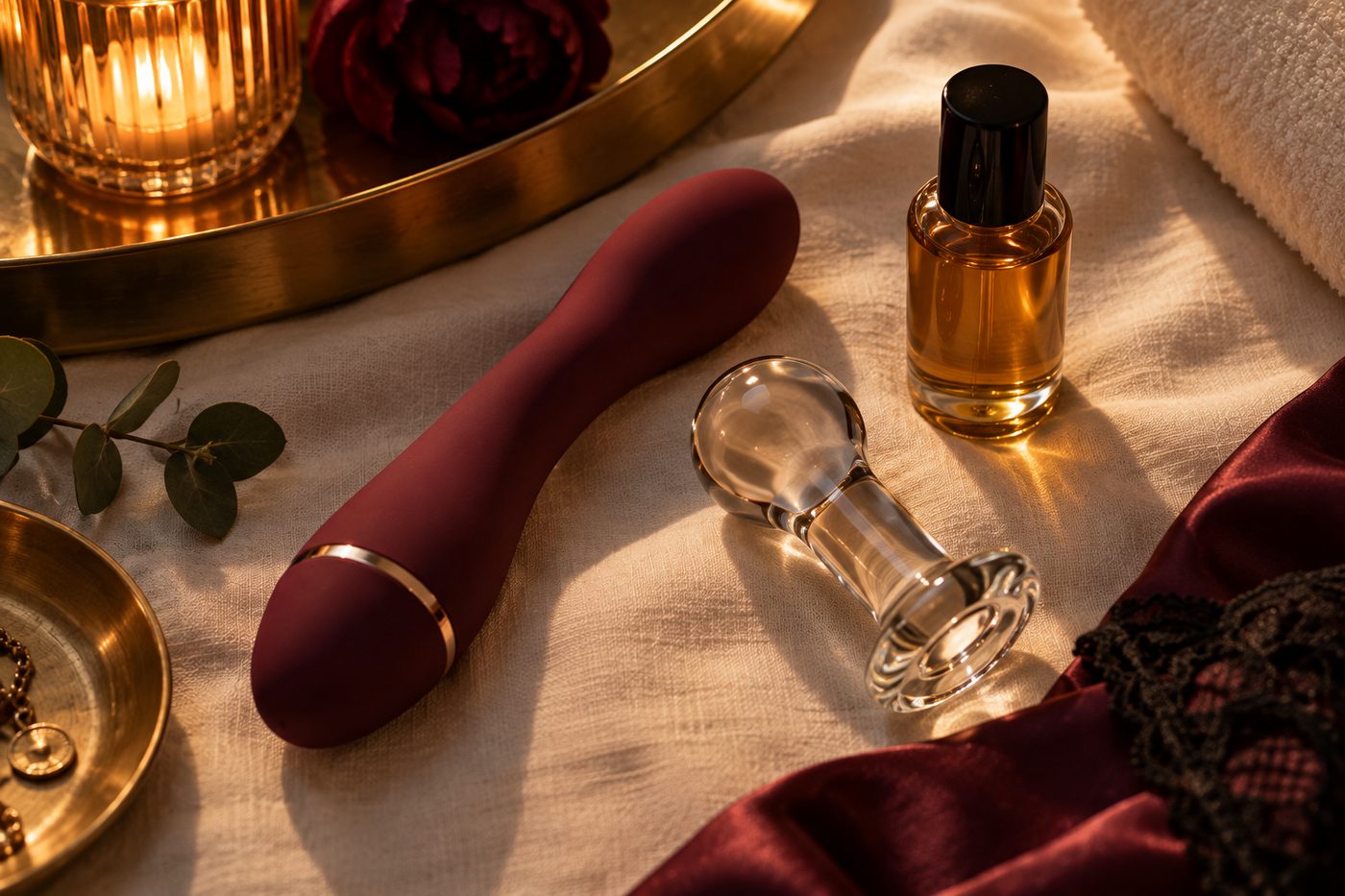
Most of what we carry comes down to a handful of materials. They are not exotic and they are not new. They are the ones that hold up to real use, real cleaning and real years.
You will notice that all of them share the same qualities: non-porous, stable, and simple to care for. If you learn these names and nothing else from this article, you will be able to shop anywhere with a clear head.
- Medical-grade silicone — soft, matte, slightly grippy. The most common good option, and the easiest to keep clean.
- Borosilicate or tempered glass — smooth, weighty, holds temperature. More durable than people expect, though not indestructible.
- Stainless steel — polished, substantial, effectively permanent with basic care.
- ABS plastic — the hard, glossy shell you will find on many handles and casings. Non-porous and perfectly sound.
- Sealed hardwood with a body-safe finish — less common, quietly lovely, and worth asking about when you see it.
Words that deserve a second look
The language on packaging is where most of the confusion lives. Terms like jelly, rubber, skin-soft blend or simply body-safe material with nothing further are not regulated the way people assume. When a label describes a texture rather than a substance, that is usually a sign the manufacturer would rather talk about feel than composition.
Two other flags: the phrase novelty use only, which is a legal shrug rather than a description, and any item with a strong chemical odour through the box. Softness alone is not a warning — good silicone is soft. It is softness combined with vagueness that should slow you down.
There is no shame in having bought something like this before. Plenty of us did, back when the shelves offered less and told you nothing. It is not a mistake so much as a market that has improved, and you are allowed to upgrade without any hand-wringing about it.
The lubricant question, in plain terms
Lubricant is where good materials most often get undone, and it is a genuinely common question at the counter. The short version: water-based works with everything, which is why it is the default recommendation and why we keep so many of them. Silicone lubricant is longer-lasting and lovely on skin, but it can react with some silicone surfaces and leave them tacky or dulled.
If you are not sure, patch test on a small spot at the base and wait a few minutes, or just use water-based and keep life simple. Oil-based products are a separate conversation again — they have their place, but they are not compatible with latex, and they are harder to rinse away cleanly.
Ingredients matter as much as the base. Ask about glycerin, fragrance and warming or tingling additives if you have ever found a product uncomfortable; sensitive skin is common and it is not a flaw. We will happily walk the shelf with you and read the backs of the bottles together, which is faster and less awkward than doing it alone with your phone.
- Water-based — compatible with everything, easy to clean, reapply as needed.
- Silicone-based — long-lasting and water-resistant; check compatibility with silicone surfaces first.
- Oil-based — rich and slow, but not for use with latex and less easy to rinse.
- Hybrids — a middle ground worth trying if water-based dries too quickly for you.

Cleaning, drying and where things live afterwards
Care is far less fussy than most people fear. Warm water and a mild, unscented soap handles almost everything, followed by a proper dry with a clean towel or a few minutes on a flat surface. The drying step is the one people skip, and it is the one that matters most, because moisture trapped in a seam or a charging port is what causes trouble later.
Storage is the other half of it. Silicone attracts lint and, depending on the formulation, some silicones can react against each other when stored in direct contact. A cotton bag, a lined drawer or the box it came in all solve this. Keep things out of direct sunlight and away from heat, and away from anything that could scratch a polished surface.
Follow the manufacturer’s instructions on anything with a motor or a battery. Some items are fully submersible, some are splash-resistant only, and the difference is not always visible from the outside. If the box is long gone, bring the item in or send us a photo through the contact page at https://www.mypleasurestore.com/contact and we will help you work out which it is.
The parts you cannot see
Two products can look identical on a shelf and be built entirely differently underneath. Seams are the first tell — a well-made piece has smooth, flush joins with no ridge you can catch a fingernail on. Rough seams are uncomfortable and they collect residue in a place you cannot properly reach.
Seals are the second. A fully sealed item with no visible battery hatch is easier to clean thoroughly and generally lasts longer. Magnetic charging, which has quietly become the standard on better-made pieces, exists largely because it removes the open port that used to be the weak point.
The third is the quality of the motor and the warranty behind it. A one-year or two-year warranty tells you the manufacturer expects the product to still be working then. It is one of the more honest signals in the whole category, and it costs nothing to ask about.

If you already own something and now feel uncertain
This is the part people worry about after reading anything like this, so let us settle it. Nothing here is medical advice, and we are not in the business of telling anyone they have done something wrong. If something you own has always felt fine, has no odour, no stickiness and no surface change, there is no cause for alarm.
If it has gone tacky, has developed a smell that survives washing, or has cracked or clouded, retire it. That is not a health verdict, just the same judgment you would make about a scratched non-stick pan. Materials wear out, and knowing when to replace something is part of looking after yourself.
And if anything has ever caused discomfort or irritation, that is worth mentioning to your own doctor rather than to us. We can talk about materials and fit and lubricant all day. We are not clinicians, and we will always tell you when a question belongs with one.
Come in and ask, that is genuinely the job
Knowledge is the best toy is one of the four promises this shop is built on, and you can read all four at https://www.mypleasurestore.com/about. In practice it means our staff would rather spend twenty minutes helping you understand a material than sell you something you will not use. Nobody will hover, nobody will make assumptions about you, and no question lands as strange — we have answered all of them, including the ones you are currently rehearsing in the car.
If you would like to see what is here before you visit, the lookbook lives at https://www.mypleasurestore.com/collection. We cannot sell online, so it is browse-only, which honestly suits this subject: materials are much easier to understand in your hands. Past pieces, including a Sex Ed with Sunny episode or two on care and cleaning, are all in the Journal at https://www.mypleasurestore.com/blogasm.
Addresses, phone numbers and hours for Huntsville, Decatur and Nashville are at https://www.mypleasurestore.com/locations, along with details of the Huntsville drive-thru if a quick, private stop suits you better than a browse. Discretion is a default here, not a favour. Come as you are, ask the thing you were not sure you could ask, and let us do the reading of labels for you.